Category Archives: Writing

This is Why Your Books Aren’t Selling: 4 Ways to Improve Now by @BadRedheadMedia


 Your Books Aren’t Selling

“My sales are awful, and I’ve done everything. I give up.” 

I heard this from three authors this week, and it’s not an uncommon sentiment right now. As an imprint director, book manager and book marketing consultant, my first questions are always:

  • What do you mean by everything?
  • How do you define “awful?”
  • What do you mean by ‘giving up?’

Let’s deconstruct four ways to improve on that!

1) What Is ‘Everything’ RE: Book Marketing?

Your definition of ‘everything’ and my definition are probably quite different. When I asked one of these authors what he’d done, he said he’d:

  • placed a few Facebook ads,
  • sent out a bunch of tweets during his free days,
  • placed a FreeBooksy promo (cost: $45). That’s about it.

To me, that’s barely scraping the bare minimum of ‘hardly anything,’ but in his mind, that’s more than he’d ever done! When I asked him what he had achieved in his marketing plan, he replied: what marketing plan?

I asked this author some of these questions, to which he answered, “no.” How about you:

  • Are you consistently on social media building relationships with readers, sharing great content, blogging and commenting on other bloggers’ sites?
  • Do you know what your keywords and branding are? 
  • Have you optimized all your social bios? Are your graphics high quality, hi-res, and consistent?
  • Growing your followings through targeted keywords? Not spamming links, but interacting and networking? 
  • Have you bought your domain, and optimized your website for SEO and SMO? Do you know your Alexa Ranking and Website grade?
  • Are you advertising?
  • Are you approaching book bloggers (politely) for reviews?
  • Participating in weekly Twitter chats and blog memes like #MondayBlogs and #LinkYourLife?
  • Do you belong to Facebook Groups where you can share ideas and partner up with other writers to promote each other? 
  • Do you regularly visit the Help Sections of all the social media channels to learn how to use them correctly? 

If the answer is no to any or all, you have work to do. You’re not doing everything, and you know it.

Again, not uncommon. Here’s the thing: art is work, to paraphrase Patti Smith. You’ve taken what, six months to two years to write your book, pouring your heart into this work. You’ve (hopefully) worked with a professional editor, graphic designer, formatter, and proofreader, and now that your book is live, you expect to sit back and watch the sales roll on in.

Wait, what?

2) Marketing Your Books is Not An Option

Why? Where does this outrageous expectation come from? I just do not get it. Writers are not dumb. Why do they think marketing is an option?

In what job in the world do you do zero work and make money?

A few tweets and an ad here and there does not create a consistent author platform, which is what this author needs — what every authors needs. This is how we meet readers, bloggers, and other influencers. This is how they find us, where the all-important word-of-mouth storm begins to swirl.

I suggested he rethink his author platform completely, create a robust marketing plan which he then implement, and lose the expectation that writing books is all about, and only about, selling books. One book will very, very rarely create an entire career for an author — and even those who do achieve those heights (Donna Tartt, The Secret History, Elizabeth Wurtzel, Prozac Nation) still go on to write more books, eventually.

I’ve worked with many authors who feel their job is only to write, and expect to do zero marketing; they feel that once they sign with a traditional or hybrid publisher, the publisher will do all their marketing for them. Big Fat Lie. The reason I have a business is because I have many traditionally published clients who are signed by those big publishers and guess what? They hire me to help them market and do their social media because their publisher does so very little marketing, if any, for them.

Do the work.

Photo source: Unsplash.com

Photo source: Unsplash.com

3) Define ‘Awful’ and Now Improve

One author sells twenty books every day and is upset because she used to sell fifty. One is distraught because she’s only selling five per day and she used to sell ten. Another has sold ten in six months. Your definition of awful is going to be different than anyone else’s, and depending on Amazon’s latest policy or algorithm change, awful can mean different things to different people.

It’s always good to keep an eye on your daily sales, but we can also become obsessed with it. My advice, take it or leave it from one who knows (I have five books out myself), is to check your sales once weekly — no more than that. This is enough to give you an idea of what’s happening during that period of time, analyze any trends, and adjust your marketing efforts. (If you are in the midst of a promotion however, feel free to check them more often, of course.)

4) Should You Ever ‘Give Up?’

  1. There is no ‘Sell By’ date on books anymore, really…especially eBooks. If you look at my third book, Broken Pieces, released in 2013, it’s currently in the #1 spot on Amazon’s paid Women’s Poetry list — and it’s been sitting pretty there since November for a few reasons you can read about here.

If you choose to give up, that’s ultimately your choice. I hear from authors all the damn time who give me every excuse as to why readers aren’t reading them, but when I ask them the questions in that list above, the answers are always ‘no, I haven’t done any of that, but…’

Oh, okay.

I can tell you this: as the director of the Gravity Imprint for Booktrope, the books that sell the most are where the authors are doing everything on that list above — they interact with readers, build their platform, generously share others’ posts and content, blog consistently, and have a clear, strong message. Take a look here at H.M. Jones, Lindsay Fischer and Lisa Douthit — their books are fabulous, all have built strong advocacy platforms (for postpartum depression, domestic abuse survivors and wellness, respectively), and they do the work. If you’d like to learn more about all the amazing Gravity authors, please visit our website!

Writing and marketing ourselves, our brand, goes hand in hand — it’s not one or the other. Writing more books will help gain you visibility, of course. The most successful authors are prolific, having at least five to ten books out — so keep at it. We are authors first. You don’t need a degree in marketing to market, just as you don’t need an MFA to write. You simply need to improve upon what you’re already doing.

It’s really not as difficult as some folks make it: step up, be smart, do the work.

***************************************

Rachel-Thompson1Rachel Thompson is the author of newly released Broken Places (one of IndieReader’s “Best of 2015” top books and 2015 Honorable Mention Winner in the San Francisco Book Festival), and the multi award-winning Broken Pieces, as well as two additional humor books, A Walk In The Snark and Mancode: Exposed. Rachel is published and represented by Booktrope.

She owns BadRedhead Media, creating effective social media and book marketing campaigns for authors. Her articles appear regularly in The Huffington PostThe San Francisco Book Review (BadRedhead Says…), 12Most.com, bitrebels.com, BookPromotion.com, IndieReader.com, and Self-Publishers Monthly.

Not just an advocate for sexual abuse survivors, Rachel is the creator and founder of the hashtag phenomenon #MondayBlogs and the live Twitter chat, #SexAbuseChat, co-hosted with certified therapist/survivor, Bobbi Parish. She is also the director of the Gravity Imprint for Booktrope, bringing stories of trauma and recovery (fiction and nonfiction) to life. Read more about the Gravity authors and their books here.

She hates walks in the rain, running out of coffee, and coconut. She lives in California with her family.

Award-winning bestsellers Broken Places, and Broken Pieces, Mancode: ExposedA Walk In The Snark (published by Booktrope)

Media consultant, Huffington Post Books blogger, creator #MondayBlogs #SexAbuseChat and #GravityChat on Twitter. 
 
Director, Gravity Imprint (stories of trauma and recovery), Booktrope 
Social Media Director, Authorbytes
Twitter – @RachelintheOC and @BadRedheadMedia 

1 Comment

Filed under Blogging, Booktrope, Gravity Imprint, Guest Post, Marketing, Writing

Are We Being Good Parents or Merely Enablers?


Photo Source: Unsplash.com/Liane Metzler

Photo Source: Unsplash.com/Liane Metzler

Recently, I’ve seen a few articles related to parenting – mature decisions that some parents have allowed their immature children (for purposes of this post, “child/ren” refers to those humans who are under the age of 15 – I chose 15, because that’s my son’s age) to make – that disturb me as a parent. So I decided to write a post about it, and I have a feeling this is going to be controversial, but SOMEONE has to ask the hard questions and point out the obvious: Are we doing our jobs as parents or are we being enablers? Read on to see what I mean.

  • If your 6-year-old son or daughter wanted to jump off of a bridge into swiftly rushing rapids, would you let them?
  • If your 13-year-old angel baby girl wanted to get pregnant and have a baby of her own, would you let her?
  • If your 9-year-old son who loves sharks wanted to swim within them in the ocean – without a protective cage – would you let him?
  • If you child decided to eat and drink out of the cat’s bowls, pee and defecate in the cat’s bin, sleep on the cat’s bed and walk around on four limbs without any clothes on, meow and hiss instead of using her words – because she believes herself to be a cat – would you allow her to do this?

If you answered no to any of these questions (and I hope you did), then what would be your answer if I asked you this question:

If your 7-year-old daughter decides that she’s a boy, wants all things boy and nothing to do with girl stuff, or if your 9-year-old son decides he’s a girl and wants nothing to do with boy stuff – up to and including an eventual sex change – would you allow them to make those choices?

These are a few of the articles in question: HERE and HERE.

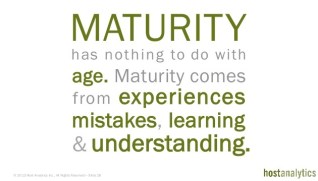
MaturityIf your answer is yes, then I ask you, why? (Let me add a disclaimer right here: I’m not into hate-mongering – neither the parent(s) nor the child. That’s not what this is about. This is about being a parent and deciding when your child is mature enough to make life-altering decisions.) Why would you allow him or her to make such a life-changing, psyche-altering decision if you wouldn’t allow them to do any of the other life-changing, psyche-altering choices I listed above? What child is mature enough, knowledgeable enough, developed enough to understand the consequences for these actions? If they are mature enough to make these decisions – and live with the resulting consequences (because, make no mistake, there WILL be consequences) – then WHY do they need parents at all?

My son would like to skip school and do nothing but play video games or Minecraft on a daily. But because I value education (and because the law requires it) I make him go to school. Yes, I allow him to game some part of most days (after school & homework & any chores I choose to make him do that day), because I believe it’s beneficial for him to learn technology and strategy and have fun. But I don’t allow him to make this decision on his own. He’s not mature enough to make the right decision. How do I know what’s the RIGHT vs the WRONG decision? I don’t. Not for sure. I have to fall back on my own maturity and knowledge – and prayer…lots and lots of prayer – and experience and insight into the world around us to make the decisions that will help my son become a well-rounded, successful, mature man. And that’s often a daunting task.

Photo Source: Unsplash.com/Sarah Graybeal

Photo Source: Unsplash.com/Sarah Graybeal

I understand that parenting isn’t an exact science. My son is 15, and I’m STILL learning what decisions to allow him to make on his own and which decisions he needs made for him…for his own good. Yes, children are people, they are individuals, they are born with free will just like the rest of us. But human children ARE NOT born with the species memory and imprint with which animal young are born.

I think this comes down to ethics and morals. One ethics and moralities question posed to a class I attended years ago was this: There’s a hungry rat and a newborn human baby in an

alley. Which – if either – would you choose to defend? That this is an ethics and moralities question says a lot about our society. And it doesn’t say anything good. There should be no question, no hesitation. My answer will ALWAYS be, the baby. Rats can defend and fend for themselves from an early age. Human children on the other hand, are not born with the knowledge and skills needed to defend or fend for themselves. That’s why they’re given parents. We are their primary teachers. We teach them manners, social interactions, ethics, morals, how to set goals and achieve them, how to shower and dress, how to be kind, but wary of strangers….we are the guardians of their innocence, the protectors of their joy and the comfort for their sorrows. Ours is such a large and daunting privilege and responsibility.

There is so much in the world that is harmful for our children. So many people who want to hurt them and lie to them. Please, let’s protect their innocence, their purity, for as long as we possibly can. They’ll lose it soon enough.

1 Comment

Filed under Family, Life, Musings, Stuff, Writing

More Practical Tips from a Grammar Goddess


In the past I’ve referred to myself as “Grammar Nazi” and “Grammar Police,” but I much prefer a recent moniker given to me by one of my talented authors: “guru goddess of editing and formatting,” which I’ve shortened to Grammar Goddess. This title implies benevolence and forgiveness, so it suits me quite well. (Stop laughing.)  And it flows off the tongue better than the other terms. Now I just need to create a logo. 😉

Now that we’ve gotten that out of the way, let’s continue my “Mind You’re Grammar” series. Part I is HERE and Part II (Deux) is HERE. And HERE is a related post about why you shouldn’t be the only editor of your own work. If you haven’t read them already, go ahead and do so. I’ll wait for you to catch up.

*************************************************

By Amador Loureiro

Photo source: Unsplash.com/Amador Loureiro


All finished? Ready for the next lesson? Here we go then.

  • “They both” and “We both.” When there are two people in a scene and both are doing the same thing, there’s no need to say “they both” or “we both.” There are only two people. The “both” is implied by “they/we.” Like so: “We decided to go to the movies.” Instead of: “We both decided to go to the movies.” You can USE “both” in this case, but it’s redundant, and if I’m your editor, I’m going to edit out that word. Just so you know.
  • “With his hands raised in the air…” Yes…of course…”raised” implies they’re in the air. If he’s going to hold his hands straight in front of him, you would say “With his hands held in front of him, palms facing me…” or some such. Or if his hands were hanging down by his sides, you would say, “His hands were relaxed, his arms hanging at his sides.” See the difference?
  • Awe vs Awww. I see this SO often, my fingers literally itch to edit…even Facebook posts, which is where I see it most often. Since the “e” is silent in any case, I understand how it can be confusing. That’s why I’m talking about it. 🙂 Awe is an expression of reverence. Aw (followed by how ever many ws you want to add (Awwwww) is used to express disgust or disbelief, sentiment or approval.
  • Flea vs flee. I know they sound the same and there’s only one letter difference, so it can be tricky, but a “Flee Market” is so much different than a “Flea Market.” The latter is where you purchase new and gently used goods that other people want to get rid of. The former is a market that I imagine only law enforcement would be interested in attending. (I don’t know why it’s referred to as a “flea” market, since, as far as I know, no one has ever tried to sell actual fleas at a market before.)affect
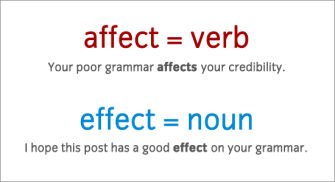
  • Affect vs Effect. Sneaky words. Only one letter different, but it can make or break the meaning of a sentence. Affect is a verb. Effect is a noun. Like so: “Together, we can affect the world.” And: “The law goes into effect at midnight.” And because the English language just CAN’T be that simple to understand, there are exceptions for both words. Affect can be a noun: “The suspect displayed no affect when confronted with his victims’ accusations.” And effect, when used with an object, can be a verb (this is usually political terminology): “We will effect those changes next week.”

Got all that? Are there any words and/or phrases you have difficulty with in your writing? Feel free to ask questions or leave comments. 🙂

Leave a comment

Filed under Editor, Literary, Literature, Proofreader, Writing